Quest 7.29 · Case-level exploratory study
Can a multimodal model combine clinical text and two DSA views to recommend an aneurysm treatment technique?
This review site summarizes the completed out-of-fold experiment and presents 16 de-identified cases for physician assessment of the model's recommendation, rationale, and uncertainty.
What has been completed
From data audit to physician-facing review
The technical pipeline is complete. Clinical validation is the next step.
Data audit
83 de-identified cases were linked to 166 PNG images. Every case has both supplied views.
Leakage-controlled evaluation
Each case appeared in a held-out test fold exactly once across five folds.
Multi-reference scoring
Top-1 and Top-2 predictions were compared with all supplied expert references, preserving disagreement.
Reasoning generation
Qwen3.6-27B generated 83 case rationales from model outputs without receiving GT labels.
Interpretation
Strong candidate coverage, limited exact agreement
Top-2 coverage is high when any expert reference is accepted. Exact agreement with the technique that was actually used remains modest, reflecting both model error and real treatment-choice variability.
Important limits
Not yet a clinical validation result
- No patient-to-case mapping was supplied; evaluation is case-level.
- The projection meaning of view a and view b remains unconfirmed.
- No independent locked external cohort has been tested.
- Generated rationales still require blinded physician review.
Qualitative physician review
16 selected de-identified cases
Selected to include confident, ambiguous, adjunctive-device, and retreatment scenarios. Reference labels are intentionally hidden.
Review progress0 / 16
Ratings are stored only in this browser until exported.
Case 1 of 16
Case 61
Awaiting review
Assigned OOF recommendation
Coil embolization alone
Alternative: Flow diversion with coil embolization
Top-1 class score73.9
Top-2 class score10.4
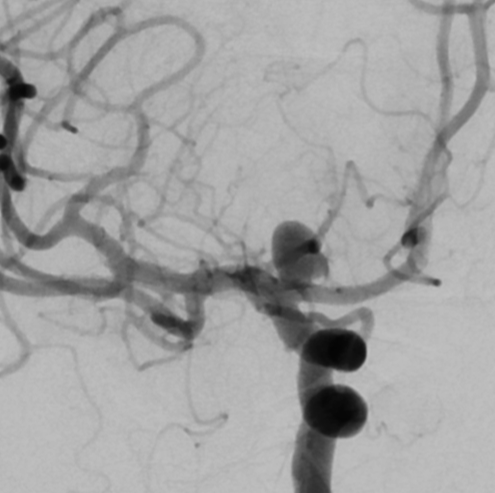
DSA view aOpen full size
DSA view bOpen full size
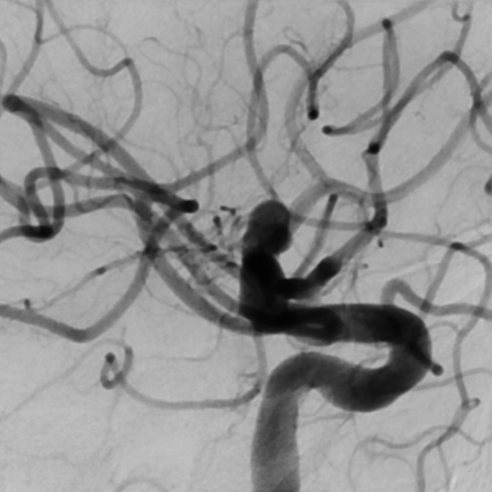
Images retain the source labels “view a” and “view b”; projection semantics have not been confirmed.
Case summary
A 75-year-old male presents with an unruptured right ACA A1 aneurysm measuring 5.3 mm × 4 mm × 5.4 mm with a 3.1 mm neck and a daughter sac.
Image observation
On the supplied views, a saccular outpouching appears on the proximal anterior cerebral artery with a visible neck connecting to the parent vessel.
Model-generated clinical rationale
The documented dimensions and neck width suggest a morphology that may be amenable to endovascular coiling. However, the presence of a daughter sac and the specific neck-to-dome ratio are critical factors that are not fully quantified in the narrative, potentially complicating coil stability.
Model uncertainty
The OOF classifier showed a relatively clear preference for coil embolization alone over flow diversion with coil embolization, but its scores are not probabilities of clinical correctness.
Clinical uncertainty / missing factor
The precise neck-to-dome ratio and the exact relationship of the daughter sac to the aneurysm neck are missing, which are essential for determining the feasibility of coil-only treatment versus adjunctive techniques.
Explicit evidence used
Unruptured right ACA A1 aneurysm · 5.3 mm × 4 mm × 5.4 mm · 3.1 mm neck · daughter sac